Monday, December 14, 2020

Moving to Burma in search of work


Where the average agricultural labourer earned just four annas a day in his native village, in Burma he could choose among various options, including dock, port, and rice mill labour and agricultural work in the rice fields, all of which could earn him from 8 to 12 annas a day. It is also telling that the immigration more or less began in the worst drought years of 1876-77. In later times of famine, when the British finally came to the rescue of the sufferers with work-for-food projects, most of the labourers who turned up were women; most of the men had apparently emigrated to Burma. Over the years, the availability of transportation in the form of regular shipping services between Koringa in Andhra Pradesh and Rangoon in Burma also helped along this wave of emigration, and as the years progressed, the number of emigrants (mostly men) kept rising.

As is still common today, labour contractors or maistries, as they are better known in northern Andhra Pradesh, played a big role in the recruitment of these emigrants. Having provided the loan required to pay for the passage, as well as food, bed, and boarding during the voyage, apart from the sums required to maintain a family in the village until the labourer could send home his wages, these maistries had a strong hold on these men. They negotiated with the employers in Burma and they distributed the wages to the labourers, taking as big a cut as they thought fit as payment for their middle-man services. However, the arrangement still turned out to be a good deal for the emigrant labourers: By the end of two to three years they would have cleared all their debts back home and even managed to save a few hundred rupees.

But this prosperous stint slowed down, first in the 1930s and early 1940s when anti-India feeling and the Japanese invasion of Burma forced many Indian workers to flee the country and later in the 1960s, when one more wave of anti-India riots forced many of them to retreat, first to Assam and later further down south.

My father’s work, in a remote station of the Indian Railways, brought us close to one such family: Apparao and Yellamma were both railway workers and Yellamma also used to work in our house as a part-time maid. With her experience as maid in an Englishman’s house in Burma, Yellamma definitely knew how to run a house, and my mother, then barely 25 years old, valued her advice on everything from stocking the kitchen to folding the napkins to raising a child. The family had travelled all the way back from Rangoon and considered themselves extremely fortunate for having found themselves government jobs. After all, they had half a dozen children to raise and no land or savings to fall back on. Later they asked for and got a transfer to Visakhapatnam, where they both retired and now live with their children.

Wednesday, July 16, 2014

Locals: The unknown, unsung heroes

History is as much about anonymous contributions as the more trumpeted ones. Who did those monks living high up on the hills of Pavuralakonda, Bavikonda, and Thotlakonda depend on for food and labor? There must have been a thriving village or two down by the sea whose residents fed the monks and worked at the monastery, but we know nothing about them.

Who were those weavers and craftsmen whose products the Europeans valued enough to cross miles of ocean to take back to their land and whose labor they tried to harness? We hear that the cloth produced in and around Vizag was highly valued, but who made it? And did these craftsmen form guilds and unions as did their more organized counterparts in the south? And did they ever sail to the Andamans and further east to Indonesia, Malaysia, and the Phillipines?

And who was this person only identified as a “native artist” who filled Patrick Russel’s publications with the most detailed and beautiful sketches of fishes and serpents that won the scientist his fame in England? We’ll probably never know.


Vizag's staple: Sketch of the king fish (Vanjaram) by an unknown "native" artist for Patrick Russel's book, "Descriptions and figures of two hundred fishes; collected at Vizagapatam on the Coast of the Coromandel." 

Thursday, July 3, 2014

Where the Dutch buried their dead

Late last year, I visited Kummaripalem (Bheemili), where, in a green plot among palm trees and weeds, the Dutch had buried their dead between 1661 and 1720. 
The Madras District Gazetteer of 1907 mentions 13 graves and all of them seem to have survived the century since it was written.
The pictures below show 2 gravestones…


…and the 13th one taken from higher up on the steps leading down from the road to the cemetery.

I could not read the inscriptions on many, and the oldest grave I could find was from 1663.


This cemetery is not as well-known as the one on the beach, which was a later addition and is better-maintained.


References Francis W., Madras District Gazetteer, Vizagapatam, (Madras, Government Press: 1907)

Tuesday, October 1, 2013

Tiger ‘rebellions’ in the hills


Print of a tiger hunt from Frank Leslie’s Popular Monthly (1878)

In the mid- to late 1800s tigers and humans waged a war in the hills of Vizagapatam district, and, as elsewhere in the country, the tigers gave way to humans, due in large part to the firearms supplied by the British. 

Government reports from the period talk about the menace caused by man-eaters to small-holding farmers in Paderu, Jeypore, Padua and other places in the Eastern Ghats surrounding Vizag.  The local people aptly called these attacks tiger fituris (tiger rebellions).

The solution hit upon by the British administration was to increase the reward for a tiger’s skin from Rs. 35 to Rs. 100. This led to an increase in the number of shikaris out to get the tigers, man-eating or otherwise, and between 1863 and 1866 rewards were distributed for 85 tigers, 365 cheetahs and panthers, 72 bears and 61 hyenas.

Caulfield's travails

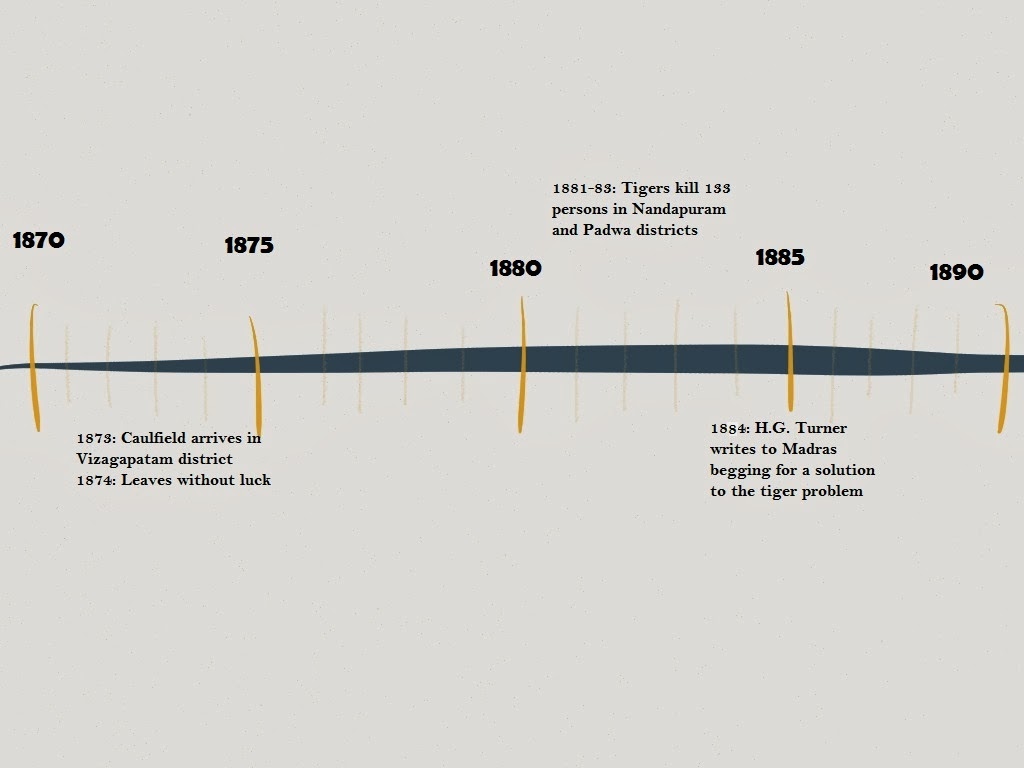
This, however, did not appear to have stopped fatal attacks by the animals, for, in 1873, we hear of the Madras Government appointing one Captain Caulfield, Superintendent of Police at Coimbatore, to hunt down man-eating tigers in Vizagapatam district.  He left Madras on Christmas Eve of that year and arrived in the district three days later.  By the 6th of January, 1874, he had set off for the hills in pursuit of man-eaters, talking to the locals, buying bait, and figuring out the tigers’ haunts. From his diary entries it appears the three principal methods to kill a tiger were trapping, poisoning (by injecting strychnine into the bait), and shooting. 

The hunt was not easy. The quarry was cunning, and even after five days of tracking a man-eater, Caulfield could not catch sight of it. Instead, one night, he was assailed by a cheetah out to eat his dog, while he was asleep in his tent. Caulfield’s group was finally forced to give up and go back to Madras after all the servants were laid down by a bout of the virulent jungle fever – what is today known as cerebral malaria.


Timeline

Turner’s plea

Ten years later, in 1884, H.G. Turner, the agent and collector of Vizagapatam made a passionate plea to Madras to take urgent measures to save the people of these hills from the tigers. He reports 40 deaths in four months in Paderu, Nandapur, Padua and Sujankota and 35 in 12 months in the circles of Lamsinghi police station. “The panic that exists here is terrible. People will not go out of their houses after dark. They are obliged to form large parties to go to market; villages are deserted; cultivation is pursued under the greatest difficulty and in constant trepidation. This morning I was shown a deserted village, abandoned on account of the tiger terror,” he says and recounts incidents of people being lifted by the dreaded beasts.

“Recently a man and his wife were ploughing a field near this abandoned village, when a tiger attacked the man in the middle of the day. He hit him with a bill hook, and the tiger turned on the woman and carried her off before his eyes. On the road I was shown two spots where the tiger carried off two men in one day. 

"Yesterday I was shown a place where a tiger sprang upon a constable, knocked him down, and mauled him so severely that he died the next day. The constable was one of a guard who were escorting about 100 people home from market. Three days ago a village munsif came to see me, with the story that a tiger got into his yard, in the middle of the village, and seized his wife, and although he beat it off, the poor woman died the next day.”

The Vizagapatam gazetteer says, “Between June 1881 and March 1883, 133 persons were killed in the Nandapuram and Padwa taluks alone.”

Villages were abandoned and people stopped tilling their fields for fear of being carried away by tigers even in broad daylight. There was a real fear that the hill tracts would soon become depopulated. The year Turner sent this report, the government distributed a number of old police carbines among the hill people to help them deal with the tigers. 

Wholesale slaughter
The gazetteer reports, “The most famous tiger of recent times was the Tentulakunti man-eater in the south of Naurangpur, which was credited with killing 200 persons before it was at length slain by Mr. H.D. Taylor, ICS, then in charge of Jeypore estate during the Maharajah’s minority.”

But he adds that this distribution of firearms along with the increase in prize money for animals led to a wholesale slaughter of wild animals in the district, with deer and bison being the most common prey.  Finally game rules had to be enforced in the district to save the wildlife that still survived.

Today we find no bison and cheetah in this region, and it was with surprise that I heard my father, who once worked in Koraput of Jeypore district, tell me that, though rare, tigers were sighted in the wilder portions of the hills, (and sometimes the not so wild portions such as railway station platforms), even as late as the 1960s and 1970s. 

Sources
1.    W. Francis, The Madras District Gazetteers: Vizagapatam, (Madras, 1907), pp. 22-23.

2. John O’Brien, Destruction of Wild Animals in Vizagapatam, The British Library: India Office Records,October 26, 2012, http://britishlibrary.typepad.co.uk/untoldlives/2012/10/destruction-of-wild-animals-in-vizagapatam.html.

3.      D.F. Carmichael, Manual of the District of Vizagapatam in the Presidency of Madras (Madras, 1869), pp. 51-52.

4.      Indian Memory Project, “77, The forest ranger of Jeypore, Orissa,” http://www.indianmemoryproject.com/?s=Jeypore#sthash.1RmLqXtn.dpbs.

5.      5. The man-eater’s jaws: Six villages in India devastated by tigers in broad day, Watkins Express sourced from London Times, October 16, 1884.


Thursday, October 18, 2012

Then and now: View from Ross Hill


Sea in the background and a channel of water in the foreground – When I saw the postcard (picture above) on the Internet, I was sure I could take the exact same picture of today’s view from Ross Hill, but was surprised at how much the place had changed. I had to do a lot of guesswork, but I think I got it almost right, except for the altitude (picture below). The channel of clear water in the first picture is now no more than a clogged drain. I’d love to know which of the old buildings in the first picture have survived. I can vaguely make out a few red roofs in the new picture and assume they’re pretty old.

Monday, October 15, 2012

In context: The Northern Circars


In reading about Vizag during the British rule, one frequently comes across the term Northern Circars. It’s a good idea to get more familiar with these Circars: Vizag’s history is intimately connected with their evolution.


The Northern Circars are a 78,000 square kilometre strip of coastal land that encompassed areas of Andhra Pradesh and Orissa, consisted of Chicacole, Rajahmundry, Ellore, Kondapalli, and Guntur.

They were originally part of the Vijayanagara Empire until the battle of Tallikota (1565), in which the Bahmani sultanate routed the Vijayanagara rulers, effectively ending the latter’s kingdom. The Circars became part of the Bahmani Sultanate and remained so for more than a century.  In 1687 they were occupied by Aurangazeb.


In 1724, Asaf Jah, the governor of Hyderabad (Golkonda), under which the five Circars were ruled, declared independence from the Mughal empire.  He claimed the title of Nizam-ul-Mulk and became the Subahdar of the Deccan.

Rise of the Vizianagaram rajahs

The Vizagapatam district was part of the Chicacole Circar and was long known as the Kasimkota division. After the Golkonda Sultanate took over, the chief local officer was the faujdar of Chicacole, who was in charge of Ganjam and Vizagapatam regions. The first faujdar was Sher Muhammad Khan (1652-84), who governed through the local chiefs or zamindars.  Among these various zamindars, the Vizianagaram rajahs grew in power gradually and started playing a significant part in the politics of the region.

The English and French had several factories in this region and struggled for commercial control of the region.  After the death of Nizam-ul-Mulk, the English and the French took sides in succession disputes. Eventually Salabat Jung, Nizam-ul-Mulk’s son, supported by the French, became the Nizam and ceded four of the five Northern Circars– Elllore, Kondapalli, Rajamundury and Chicacole–to the French in 1753.

English supremacy

But in 1759 the success of the combined forces of the Vizianagaram rajahs and the English established English supremacy in the Circars; in 1765 Robert Clive obtained the Northern Circars from the Mughal Emperor, Shah Alam, by way of inam or free gift subject to an annual payment.  Though the Nizam contested the validity of Shah Alam’s inam, the British, through a combination of force and diplomacy, obtained the Nizam’s acknowledgment of their right to the region and in 1823, the British bought the rights over the Circars from the Nizam.

Since the establishment of the company's government the whole province was divided and placed under two subordinate councils of which the larger was that of Vizagapatam, which was nearly "centrical to all the circars". About the middle of the I7th century a factory was established at Vizagapatam where, on the cession of the Circars, the chief-in-council was appointed.


Too attractive to resist


No one valued the Northern Circars more than the British, or rather, the Europeans. For landlocked Hindu and Muslim kingdoms, the thin strip of coastal territory was too far-flung and too wild to be brought under proper control. Tribal chieftains, hill zamindars, and local self-styled landlords made use of the sturdy, malaria-ridden barrier of the Eastern Ghats to keep central rulers away from the circars and run their own show.

However, the Nizam of Golconda as well as the emperors of the disintegrating Mughal empire dangled the carrot of the Northern Circars to get what they wanted from the British and the French.  Whenever they wanted British or French help in the form of troops or money, the Mughals and the Nizams would promise the Europeans more concessions in or control over the Northern Circars. And the Europeans always took the bait; for the sea-faring traders, the long strip of sea-coast was too attractive to resist. 

Sources:
M.S.R. Anjaneyulu, Vizagapatam District, 1769-1834: A History of the Relations Between the Zamindars and the East India Company, Andhra University, 1982

Wednesday, October 3, 2012

Arthur Cotton: A fruitful sojourn in Vizag

Sir Arthur Cotton, who gained fame and admiration throughout South India by reining in the powerful rivers of the region and is said to have been responsible for the bright green hue that is so integral a feature of the Konaseema region, lived in Vizag for a couple of years (1843-44) to recover from the ‘jungle fever’ that haunted him throughout his stay in the tropics.


His was a genius that could not stay idle even in illness. While nowhere on the scale of the ambitious projects on the Kaveri and the Godavari, Sir Arthur’s work in Vizag was not mean by any measure. He developed the groynes in the sea, which helped break the waves and control erosion. He redesigned and rebuilt St. John’s Church and drew plans for a port in the city.

The family lived in a house among the dilapidated barracks on Dolphin’s Nose, with just one neighbor – the Chaplain – who had built himself a house on the hill. From what Elizabeth Hope, Sir Arthur’s daughter writes in her biography of her father, the view seemed to have compensated for the loneliness of their living quarters: “My mother says of the experience of that time – ‘The view from the Dolphin’s Nose was very fine. The hill rose abruptly from the sea, and the great depth, looked down upon from the top, was sometimes awe-inspiring. Hawks and other large birds of prey above wheeled ceaselessly in circles, uttering their wild, weird cry.”

Source:
Hope, Elizabeth, Lady; Digby William, General Sir Arthur Cotton, R.E.K.C.S.I, London, Hodder & Stoughton, 1900

Tuesday, August 21, 2012

A church for the Uplands

In the early 1800s, Waltair Uplands was the preferred place of residence for the British population, at least those of them who were elevated enough on the government ladder to deserve one of the pretty white-washed bungalows that dotted the hilly places all along the coast. The devout among these fortunate people, however, faced a problem. The only church for Europeans was located in the Old Town, four or five miles away from the Uplands, a not inconsiderable distance in those days.

Though it was easy enough to come up with the idea of building a new church in the Uplands, funds for churches were not easy to come by at the time, as the British East India Company left religion alone as a matter of policy and rarely paid up for churches, orphanages, chaplains or such other religious paraphernalia.

The chaplain of Vizagapatam, Vincent Shortland, raised the money from the congregation; in fact it was the congregation that paid for the furniture and most repairs over the next several years. Captain J.H. Bell of the Madras Engineers designed and supervised the construction of the building, which could house 150 people. The church -- named after St. Paul -- was completed in 1838 and consecrated by one Bishop Spencer.

Apart from the addition of a belfry in 1863 and the rebuilding of the same structure after it was destroyed in a cyclone in 1872, on the opposite side of the original one, the church has survived until today almost unaltered.

Thursday, August 2, 2012

Good Friday at St. Paul's Church


It was squally in the morning but by afternoon the sun had torn itself free of the still lingering clouds and had begun to evaporate the odd puddle, with the result that the atmosphere was moist and hot and, on the whole, unbearable.


At St. Paul’s church, there was a pile of shoes outside and a pile of people inside. The old, white-washed structure peeped out from behind modern palms and as I stood outside waiting for my little girl to catch up with me, the entire impression was one of pleasant luxury.

Inside, sunlight streamed through the open windows painted a pale cream, but for some reason, the church’s organizing committee thought it fit to switch on the tube lights, whose ghostly white light clashed with the sunshine and made sure there were no shadows anywhere. I wished the power would be switched off for a while, though the heat might have made me delirious, just so that I could see what the place looked like back when it was built – 1838.

The girls were drably dressed because Good Friday was no day to deck up in diamonds, fake or real. The men were, as usual, all brown, black, white and grey. The pastor’s voice sounded sonorous through the microphone but when my wish was granted and the power was switched off, his real voice revealed itself as puny and would not carry across the aisles and upstairs to the balcony seats. So he stopped speaking until the generator was switched on and then his voice was back to its sonorous self, except that it now had to compete with the generator’s drone.

I was deaf to the meaning of the pastor’s words but his voice filled me with great peace. It probably had a similar, though, soporific effect on my girl, and she soon fell asleep with her feet in my dad’s lap and her head in mine. So, though the entire congregation rose and sat on orders from the pastor at regular intervals, I stuck to my chair and my mind hovered in that pleasant area between sleep and wakefulness, which often gives the impression that it delivers deep insights, but usually only results in some vague but commonplace ideas.

Wednesday, July 18, 2012

The steep climb to Araku

The first few British expeditions to Galikonda were localized to the area now known as the Araku valley and were a far cry from today’s tourist sojourns in well-equipped, if not luxurious, resorts.

The first exploratory team that went up Galikonda and the surrounding plateaus in February, 1859, consisted of five members led by the Inspector General of Hospitals, Dr. Duncan McPherson, under orders by the Commander-in-Chief of Madras, Sir Patrick Grant, to see whether the hill would make a good sanatorium for soldiers serving in the ‘Northern Division’ of the Presidency.

They explored a few ridges and ranges and named the saddle that joins the crescentic ridge of Galikonda Grant’s Ridge (after the Commander-in-Chief); they selected a valley 600 feet below Grant’s Ridge for the sanatorium and named it Harris Valley, quite a misnomer, as it is more a plateau than a valley, located a vertiginous 4,000 feet above the sea.

Later that year a company of 60 Sappers (soldiers) cleared the ground and cut out approach routes.

In March the next year a group of 21 men of the European Veteran Company at Vizagapatam tested out the climate and living conditions in the valley. The expedition can only be called a disaster. With little more than thatched huts to protect them, these soldiers, mostly older veterans, faced the full fury of rain and wind and the malaria parasite. Only one of them escaped sickness. One can imagine the men trying to weather it out among the thick fogs common to the region, foliage dripping rain and the choppy breezes chilling them to the bone. Three of these men died, two on the hills and one on the way back to Vizag.

The Government, however, unwilling to concede victory to Nature’s forces, sent another party of younger European soldiers to the valley in May; but sickness attacked all but one man of this group too.

After trying out other locations such as Kapkonda, a higher hill, the venture was abandoned in 1861. I can’t claim to have tried very hard, but from the few sources I referred I’m unable to gather when the Araku valley was finally tamed.

References:

Francis, W. – “Vizagapatam District Gazeteer”; Asian Educational Services; first published, Madras 1907


Tuesday, May 8, 2012

Visakha Museum


A visit to the Visakhapatnam museum last month proved to be a disappointing affair. The objects on display were a motley collection, mostly donated by eminent and not-so-eminent citizens; most were of doubtful historical value. For instance what’s the historical value of currency notes from Latvia donated by a Latvian citizen who visited the museum a couple of years ago? Or the collection of modern coins from a dozen countries around the world? Or the modern paintings by just a couple of painters? It looked as if the museum was just kind enough to accept whatever people offered, without trying too hard to acquire anything by itself.


However, there were a few objects that made my visit worth the trouble -- a telescope from the old observatory, some old photographs of the city’s coastline, and larger-than-life portraits of the Vizianagaram and Bobbili rajahs (placed facing each other!) But the most interesting exhibits stood outside, in the cool gardens and lawns around the pretty Dutch building (which houses the museum). Among them I found this rock edict commemorating a change in the city’s name.


The entry fee was around Rs. 10 for an adult and Rs. 5 for a child. Unfortunately for me, the Maritime Museum, housed in the first building on the left, was closed for renovation when I visited. So all I could look at was the things in the old building.


Friday, December 16, 2011

Echoes 3

“What she was finding also was how one book led to another, doors kept opening wherever she turned and the days weren't long enough for the reading she wanted to do. ”
Alan Bennett

Tuesday, December 13, 2011

An article on the Vizag observatory

For those interested in knowing more about the observatory in Vizag, here's the link to an article written by N. Kameswara Rao, A. Vagiswari and Christina Birdie in Current Science, Vol. 100, No. 10., published in May this year.

It's titled, "Early Pioneers of Telescopic Astronomy in India: G.V. Jaggarow and his Observatory" and is a detailed account of the founder of the observatory and those who ran it after him, the setting up of the observatory, the equipment acquired, the work carried out there, and its fading away. All this information is skillfully placed in the context of contemporary astronomical research in India and abroad.

Monday, December 12, 2011

Thomas Bowrey: The Inspiration Behind the Vizag Factory?


The origins of Vizag’s European settlements date back to the mid-to-late 1600s according to the Vizagapatam Gazeteer, W. Francis. “The settlement was founded in 1682. In February of that year the Directors wrote to Fort St. George that an interloper (unauthorized trader) was designed for Metchelepatam or Gyngerlee (i.e., Mausulipatam or Vizagapatam) and left it to the Madras authorities to decide whether a factory should not be established at the latter place. The Madras consultations of the 1st August 1682 say that ‘The Company having resolved to make some investments this year at Gingerly & given order to send down some persons to further the same, as likewise to hinder and defeat any Interlopers that shall come there, resolved that Mr. George Ramsden doe proceed for this year as Chiefe there, his Second in Council being one Clement du Jardin. Thus it is clear that it was largely fear of the rivalry of the ubiquitous interloper which led the Company to first settle in Vizagapatam.”

Thomas Bowrey’s name occurs in a footnote to this text, but it is not clear whether this ‘interloper’ who inspired the English to set up a factory at Vizag was Thomas Bowrey or not. He does seem to have had some connection with this episode: one of his ship’s mates, Clement Jordan (who later changed his name to du Jardin) became one of the key persons in setting up the factory in Vizag. The links, though, are difficult to pin down based on my current reading.

Captain Bowrey (as Thomas was commonly known in English records) did, however, describe the coast around Vizag (Gingalee) in his book “A Geographical Account of the Countries Around the Bay of Bengal”. He calls this area “Certainly the most pleasant and Commodious Sea Coast that India affordeth, pleasant in many respects, beinge a most delicate Champion Land, and one of the most fertile lands in the Universe, and Commodious for Navigation’s Sake, enjoying many pleasant and good harbours, very well populated, and of a reasonable good Extent.”

Thomas Bowrey’s life (or whatever could be put together by Lt. Col. R.C. Temple in his introduction to the above-mentioned book) is an interesting one.

He sailed for the East from England while still in his teens. During his 19 years in the Eastern Hemisphere, he mainly traded in pepper, cloth and tea, but his time there was a far cry from the mundane buying and selling of goods. It was also full of adventure: he was imprisoned and put in irons and was witness to mutiny in Ceylon and a massacre in the Mergui archipelago (in southern Burma). He also drew charts and pictures of various places he visited, the best known being his chart of the Hoogli river.

In 1688, he left Fort St George (Chennai), apparently for good, and set sail for England. On his long journey back home, he put his time to good use and put together material for an English-Malayo (a far Eastern language) dictionary, which was published in 1701. He later married and probably still traded, possibly in the Western part of the New World.

When he was well into his 50s, his wanderings came in useful for Daniel Defoe (author of the widely read Robinson Crusoe), who gathered from Bowrey information on which to base his book -- “A General History of the Pyrates”, in particular information about piracy in Madagascar and Indian waters from 1695 to 1705.

References:

1. Thomas Bowrey -- "A geographical account of countries round the Bay of Bengal, 1669 to 1679" -- Edited by Lt. Col. R. C. Temple; C.I.E., Haklyut Society; 1905


2. Francis, W. – “Vizagapatam District Gazeteer”; Asian Educational Services; first published, Madras 1907


3. Daniel Defoe – “A General History of the Pyrates” – Edited by Manuel Schonhorn; Dover Publicatio; 1999


Friday, December 9, 2011

What's gingelly got to do with it?


Gingelly grains

A previous blog of mine (see link), in tracing Vizag's history, mentions that European traders referred to the coast between the Godavari and Puri as Gingerlee. I kept wondering where in the world that word came from. Some light crept into my sleepy brain last night as I looked through the Hobson-Jobson dictionary. The book says the word possibly originated from the Portuguese word for sesame seeds “Gergelim”; the English too called the sesame seed oil gingelly oil.


Hobson-Jobson says: “The following quotations show that Gingerlee or Gergelin was a name for part of the E. coast of India, and Mr. Whiteway conjectures that it was so called because the oil was produced there.

1680-81 – ‘The form of the pass given to ships and vessels, and Register of Passes given (18 in all), bound to Jafnapatam, Manilla, Mocha, Gingerlee, Tenasserim, & c.’ Fort St. Geo. Cons. Notes and Exts., App. No. iii. P.47


“1701 – The Carte Marine depuis Suratte jusq’au Detroit de Malaca, par le R. Pere P.P. Tachard, shows the coast tract between Vesagapatam and Iagrenate as Gergelin.


“1753 – ‘Some authors give the Coast between the points of Devi and Gaudaweri, the name of the Coast of Gergelin. The Portuguese give the name of Gergelim to the plant which the Indians call Ellu, from which they extract a kind of oil.” – D’Anville, 134.


“(Mr. Pringle [Diary Fort St. Geo. 1st ser. iii. 170] identifies the Gingerly Factory with Vizagapatam).”


References:

Thomas Bowrey -- "A geographical account of countries round the Bay of Bengal, 1669 to 1679")


Henry Yule, A.C. Burnell, and William Crooke – “Hobson-Jobson – A glossary of colloquial Anglo-Indian words and phrases”


Thursday, December 8, 2011

Copper “dubs” from Bheemili


A Dutch-minted Mughal copper coin - 1719-48


I’m now sure that Bheemli had a mint, but am unable to find any reliable source that gives the details. Some entries on the forum, www.worldofcoins.eu, say that the Dutch did issue copper dubs (check out the resemblance to the Telugu word for money: “dabbu”) in Machilipatam, Jaggernaikpur (Kakinada), and Bimlipatam. The dubs were a continuation of a type of coin introduced by the Mughal emperor, Aurangazeb Alamgir.

The entries say the mint in Bimlipatam was established under authority of a grant by the Raja of Vizianagaram; it is supposed to have minted copper dubs at least up to 1794.

These entries also mention an English mint in Vizagapatam, which started minting dubs in 1797 and continued to do so on and off until 1809, when it was shut down.

Sunday, December 4, 2011

Bheemili's Copper Purchases

According to the book “The Intra-Asian Trade in Japanese Copper by the Dutch East India Company” by Ryuto Shimada, Bimlipatam bought 50,000-100,000 Dutch pounds of Dutch-imported Japanese copper in 1700-02 and over 100,000 Dutch pounds of copper in 1740-42, figuring among the largest buyers of Dutch-imported copper in South Asia.


What was it doing with all this copper? Did it have a mint?

Friday, December 2, 2011

What's this War that Ravaged Bheemili?

While reading an article from the Oriental Herald (dated October 1829) by James Silk Bukingham, I came across the following passage about Bimilipatam:
“After some little detention at the warehouse in dispatching off to the ship some bales of punjum (calico) which we were to take to Bengal I found a conveyance ready to take me to Mr Suter's house which was nearly four miles in the country. In passing along the skirts of the town the ravages of war were most apparent and among a number of buildings seemingly battered down by cannon was a large edifice with a highly ornamented facade which had been probably the residence of the former Dutch governors. Several still larger buildings, probably barracks and military store houses, were also seen in ruins and the place looked to us if it had been once abandoned and but now recently peopled again. This settlement having formerly belonged to the Dutch had come into our possession during the late war and had been restored again to the Dutch by the English East India Company.”

I wonder which war is being referred to here: a war whose battle or battles destroyed Bheemli and the Dutch colony there. Is it one of the Anglo-Dutch wars that the English and Dutch fought to control trade in Asia? If so, the last one was fought in 1780-84, and it’s hard to imagine that the town had this ravaged look more than 40 years after whatever battles were fought there.

Sunday, November 27, 2011

A Page 3 Party at Vizag in 1828

“On the 22nd of May a splendid entertainment, consisting of a dinner, a dance, and a supper, was given by Goday Sooria Narrain Row, a distinguished and opulent native, to the ladies and gentlemen of the European portion of the community, on the occasion of the marraiges of his son and daughter…” begins an article in the Asiatic Journal and Monthly Miscellany, Vol. 25. The Sooria Narrain Row (Gode Suryanarayana Rao) mentioned here is the father of Mr. Jagga Rao of our observatory fame (see blog January 29, 2010). The marriages had earlier been performed in the Indian style, and this party was chiefly a reception for the European crowd.

The reception was held at Mr. Row’s mansion, where a pandal was erected, leading to the garden house; dinner was served in a brilliantly lit hall with ‘superb mirrors’ at either end of it and decorated with European engravings. A lamp with ‘richly painted moons’ hung over the table. As for the dinner, it had “every dainty usually served up at an English entertainment, an excellent desert, choice wines and other beverage.” And as if this were not sumptuous enough, at midnight, supper was served, which “might well have done duty for a dinner.”

While some of the crowd danced, “others were amused by the exhibition of a fine set of native dancing-girls, and a display of blue lights and fireworks... Amongst the novelties of the evening was the exhibition of a Highland piper in the service of his Highness (the Rajah of Vizianagaram who was among the guests), who, in full costume, played reels, pibrochs and laments, and who was no contemptible performer on the pipes of his nation. ”

“The ladies retired at rather an early hour, occasioned probably by the great heat: but many gentlemen tarried over the bottle in due respect to the exertions to please their hospitable entertainer, and retired not until pleasure was in danger of becoming a fatigue.”

The guest list included around fifty Europeans from Vizagapatam and neighbouring stations and the Rajah of Vizianagaram.

Source: The Asiatic Journal and Montly Miscellany, Vol. 25.


About the Asiatic Journal
“The Asiatic Journal and Monthly Miscellany” has some “miscellaneous” stories about the East India Company-dominated areas of Asia. It was published twice a year and I imagine its contemporary readership included people in Asia who wanted to know what was happening to their kin in the region and people in Britain who had Indian or Asian connections.

It gave details of births, marriages, deaths, appointments and transfers of people of British origin living in the East, which items were probably read as we read obituaries, wondering if we’ll find in them the announcement that someone we distantly know had died.

As far as Vizag goes, there are few entries, four or five announcements about deaths, births etc. per issue and occasionally, maybe once in three years, an article about some event of importance in the settlement. The few entries breathe life into the wood and clay characters of history.

Thursday, November 24, 2011

Where the monks meditated

Here’s a link to a blog with beautiful pictures of Thotlakonda . Very atmospheric !

http://huqelberry.com/bavikonda-and-thotlakonda#!/